0 Likes
The suburban night in Las Piñas is thick with a specific kind of stillness—the kind that feels heavy, not just with the April humidity, but with the quiet intersection of life and memory.
It is the night of April 14, 2026. I am standing on St. Charles Street, the cool hum of the evening wrapping around me. Before me, the small chapel—a modest structure that, were it not for the arched steel gate, would easily be mistaken for just another residence.
Above me, the banderitas are suspended across the street. They are remnants of the recent town fiesta, their colourful triangles hanging still in the breathless air. Under the amber wash of the suburban streetlights, they seem to vibrate with a festive energy that feels almost surreal against the silence. It is a visual paradox: the streets are decorated for a grand celebration, yet the pavement is empty, save for my own shadow.
The silence is deep, punctuated only by the distant, muffled cadence of a city that has finally tucked itself into bed. But as I look toward the chapel, I understand the hush. A wake is being held inside.
The vibrant, joyful banners of the fiesta now serve as a backdrop to a much more intimate, somber reality. It is a profound, familiar duality—the community’s celebration and its mourning occupying the same narrow street, bathed in the same artificial light. I frame the shot, keeping my camera steady. I am capturing more than just the architecture; I am documenting the stillness of a neighborhood in transition. I am archiving the quiet aftermath of a festival, the gentle solitude of a wake, and the unseen pulse of a community that, even in its sleep, remains draped in the colours of its faith.
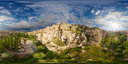
When I look at this 360-degree frame later, I won't just see a chapel on St. Charles Street. I will see the silence of a Tuesday night in April, the vibrant ghost of the fiesta hanging overhead, and the profound, quiet grace of a neighborhood paying its respects.
...


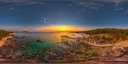
The Philippines are an archipelago of more than seven thousand islands off the southeast coast of Asia. Only half of these islands have been named and roughly one thousand are inhabited. Look at how beautiful they are! People first arrived here from the mainland around 25,000 B.C. by crossing a land bridge which existed at the time.The name comes from Ferdinand Magellan of Portugal, who explored the Philippines in 1521. He claimed them in service of Spain, naming them after Prince Philip. Spain controlled the Philippines for the next 350 years until the Philippine Revolution of 1896.Here's a picture of Fort Santiago, where the national hero Jose Rizal was imprisoned prior to his execution. He was a poet and novelist who supported peaceful reform, rather than violent revolution, against the Spanish government.This is one of poems in which he describes the creation of the world, as a gift to his mother:"Say they that tell of the world, the first dawn of the sun, the first kiss that his bosom inflamed, when thousands of beings surged out of nothing, and peopled the depths, and to the heights mounted, to wherever his fecund kiss was implanted"Violent revolution broke out anyway and the Philippines changed hands from Spanish, to American, to Japanese control over the next fifty years. Following World War Two they finally became an independent republic.Back to the beautiful ocean! You can dream about the Cafe Del Mar resort next time you find your screen saver kicking in when you're still sitting at the desk staring blankly. There's a series of DJ mixes with this title but I don't know if it refers to the same place. I would not be surprised.Annnnd to really get you buying your plane tickets...the sunset over Borocay White Beach!Text by Steve Smith.